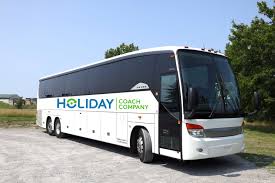
How to evaluate charter and coach bus companies near you — DOT/FMCSA safety checks, fleet and amenity matching, quote line items, and a booking checklist for reliable Midwest and nationwide group transportation.
Top Charter and Coach Bus Companies Near You: How to Choose the Right Provider
Booking group transit takes more than tallying heads and matching seat counts. Details matter. Whether you run a regional conference, manage campus athletics, set up daily worker shuttles, or transport wedding guests, the carrier behind the wheel dictates if your people arrive safe, relaxed, and on schedule.
A quick search for local charter buses usually turns up a messy blend of fleet owners, digital brokers, and municipal lines. Location alone tells you very little. To find a partner you can trust, check DOT safety filings, inspect fleet condition, demand upfront pricing, and test how fast dispatch answers the phone.
Here is how you evaluate local coach operators, select the right vehicle class for your itinerary, unpack line-item quotes, and secure reliable service. Holiday Coach Company is a Midwest-based carrier operating nationwide charters and regional shuttles — learn more about Holiday Coach and our safety-first operations.
What to Look for When Searching for Charter Bus Companies Near You
A close bus yard helps, but geography alone will not keep your schedule intact or your passengers safe. You want an operator that steps in as an actual partner on your logistics roster. That means finding a team that sorts out tricky staging permits, plans alternate routes before gridlock hits, and manages every detail that keeps groups comfortable on the road.
Focus on three essentials: proven federal compliance, real local dispatch power, and live operational support.
| Evaluation Pillar | What to Verify |
|---|---|
| Safety & DOT Compliance | FMCSA SAFER record, valid USDOT/MC authority, driver Hours-of-Service caps, strict drug screening |
| Local Dispatch & Route Efficiency | Low deadhead mileage, local route knowledge, 24/7 live dispatch desk, rapid backup equipment |
| Fleet Quality & Modern Amenities | Minibus to 56-passenger range, onboard Wi-Fi and power, climate control, ADA accessibility, clean lavatory |
Verifying DOT Safety Records, FMCSA Compliance, and Driver Qualifications
Safety is non-negotiable. Legitimate carriers operate under Federal Motor Carrier Safety Administration (FMCSA) oversight within the U.S. Department of Transportation (USDOT).
Run through these checks before you wire a deposit or sign any paperwork:
- Inspect the USDOT and MC Numbers: Interstate carriers must hold active USDOT and Operating Authority (MC) registrations. Get these digits from the company and look them up directly in the FMCSA public SAFER database.
- Review the Safety Rating: Federal audits and roadside checks yield three possible grades: Satisfactory, Conditional, or Unsatisfactory. Skip any operator carrying a Conditional or Unsatisfactory score.
- Confirm Insurance Coverage: Federal rules require passenger carriers running vehicles for 16 or more riders to maintain at least $5,000,000 in public liability and property damage coverage. Ask for a formal Certificate of Insurance (COI) that lists your group or school district as an additional insured.
- Assess Driver Screening and Training: Pull back the curtain on driver qualification files. Solid operators require a commercial driver's license (CDL) with passenger endorsements, current DOT medical cards, pre-employment drug screening, random drug tests, background checks, and regular defensive driving training.
- Enforce Hours of Service (HOS) Regulations: Federal law caps passenger-carrying drivers at 10 hours behind the wheel following 8 straight hours off duty, with a hard ceiling of 15 total on-duty hours. Long itineraries demand a relief driver or scheduled driver rotations to keep the trip legal and safe.
Local Dispatch, Deadhead Mileage, and 24/7 Customer Support
Understanding how an outfit handles dispatch keeps surprise fees off your invoice and prevents your group from standing on a curb waiting for a late coach.
Deadhead Mileage and Fleet Proximity
Deadhead measures the empty miles a bus rolls between the garage and your pickup spot, plus the return run back to the barn after drop-off.
You pay for that empty transit through fuel charges, driver hourly wages, and vehicle wear. Booking with an operator that keeps yards or established dispatch staging directly inside your metro market cuts down those non-passenger charges immediately.
24/7 Live Operational Dispatch
Things go wrong on the road. Flight delays happen, expressways shut down, and timelines shift mid-event. An answering service or daytime-only office line will not help you during a 4:30 AM airport pickup or a midnight conference run.
Work with a carrier that runs an active 24/7 dispatch desk. You need human dispatchers who monitor live GPS feeds, steer drivers around unexpected highway backups, and dispatch backup equipment immediately if a mechanical issue arises.
Choosing the right bus size and cabin features
Mismatched sizing creates headaches fast. You either burn budget on empty rows or watch luggage pile up on the curb because a shuttle was too small. Most group transport runs on two workhorses: mid-size executive 25-passenger minibuses and 56-seat highway coaches.
| Vehicle Class | Seating Capacity | Best Use Cases |
|---|---|---|
| Executive Minibus | 24 to 38 passengers | Local corporate shuttles, wedding guest transport, short airport transfers, urban hotel-to-venue runs |
| Full-Size Motorcoach | 50 to 56 passengers | Long-distance group tours, collegiate athletic trips, large corporate summits, multi-day school outings |
Minibuses compared to full-size coaches
Executive minibuses with 24 to 38 seats
Built on medium-duty frames, minibuses thread easily through congested downtown streets, tight historic districts, and hotel drop-off loops where a 45-foot coach simply cannot turn.
- Luggage Capacity: Space is tight. You get small rear storage compartments or overhead racks built for backpacks, briefcases, and light carry-ons. They rarely handle full-size checked bags for everyone on board.
- Best Application: Quick hotel shuttles, wedding parties hopping between venues, corporate campus loops, and local private sightseeing.
Full-size coaches with 50 to 56 seats
These are the heavy-duty rigs built for long interstate hauls. Monocoque frames absorb highway bumps and carry serious cargo underneath.
- Luggage Capacity: Deep underfloor belly bays hold heavy gear bags, trade-show freight, band gear, and rolling suitcases for up to 56 riders, plus standard interior overhead bins.
- Best Application: Multi-day school tours, university athletic road games, massive corporate conferences, and cross-state group charters.
Key cabin amenities from Wi-Fi to restrooms
Think of modern coaches as rolling offices or quiet lounges. Tell your dispatcher up front which specific features your route requires:
- High-Speed Onboard Wi-Fi: Crucial for remote employees answering email, students finishing assignments, or passengers streaming media across empty stretches of highway.
- Individual Power Outlets and USB Ports: Row-by-row 110V plugs and USB jacks keep phones and laptops from dying halfway through the trip.
- Onboard Restrooms: Standard inside 50 to 56 passenger coaches, an onboard lavatory cuts out unscheduled highway rest stops to protect your arrival window. Minibuses rarely have them.
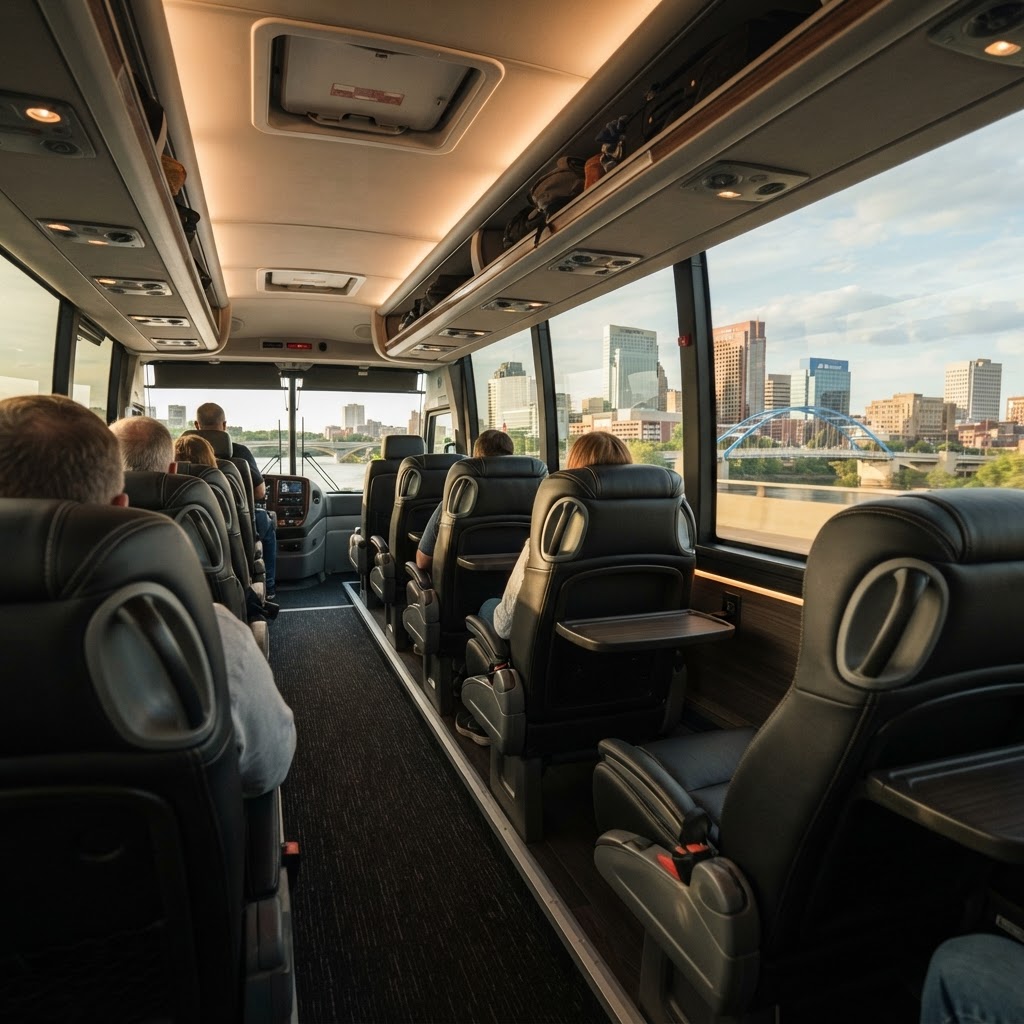
- Climate Control and Ergonomic Seating: Reclining high-back seats, tinted panoramic glass, personal reading lights, and dedicated overhead air nozzles keep riders comfortable over long five-hour stretches between hotel stops.
- Audio/Visual Entertainment Systems: Flat screens, PA microphones, and DVD or HDMI inputs let coaches review game film, tour guides narrate city landmarks, and planners brief their teams.
- ADA Accessibility: If anyone in your group uses a wheelchair or needs boarding help, request an ADA-compliant coach equipped with an inspection-certified lift, widened entry doors, and secure floor tie-downs.
Comparing Leading Regional and National Charter Bus Providers
Picking the right carrier comes down to footprint, equipment quality, and how fast someone answers the phone when plans change. Here is how key regional and national operators stack up across the country.
| Provider | Service Footprint | Fleet Composition | Key Strengths | Operational Focus |
|---|---|---|---|---|
| Holiday Coach Company | Midwest Regional Hubs & Nationwide Charters | Modern 24–38 passenger minibuses, 50–56 passenger motorcoaches, executive black cars | High-touch customer service, 24/7 live dispatch, modern Wi-Fi/power-equipped fleets, rigorous safety standards | Custom corporate charters, private events, athletic teams, university transport, and recurring shuttles |
| Barons Bus | Midwest & Great Lakes (OH, IN, MI, PA, WV) | Full-size motorcoaches (predominantly 56-passenger) | Strong regional scheduled intercity network alongside charter capabilities; modern fleet with standardized amenities | Regional intercity point-to-point routes, group charters across the Rust Belt and Midwest |
| Academy Bus | East Coast, Mid-Atlantic, Southeast | Full-size motorcoaches, mini-coaches, transit buses | Extensive terminal network along the Eastern seaboard; high vehicle volume for large-scale operations | Commuter transit contracts, major stadium events, multi-bus East Coast group logistics |
| Coach USA | National footprint (various operating subsidiaries) | Large-scale transit, double-decker, and motorcoach fleet | Broad geographic footprint via regional sub-brands; extensive scheduled airport and commuter corridors | High-density urban commuter corridors, scheduled airport express lines, large public-sector contracts |
Provider Profiles and Practical Considerations
Holiday Coach Company
We run our operations out of the Midwest while handling charter trips across the country. Fleet size matters, but direct access to dispatch matters more. Our lineup spans executive black cars, 24 to 38-passenger minibuses, and full-size 56-passenger motorcoaches fitted with Wi-Fi, power ports, and spotless onboard restrooms. Live 24/7 dispatchers and verified FMCSA safety compliance back every trip, so group coordinators never get left guessing.
Barons Bus
Barons Bus covers Ohio, Indiana, Michigan, Pennsylvania, and West Virginia. They built their reputation on scheduled city-to-city transit and clean equipment throughout the Rust Belt. Regional trips work well with them. However, planners needing nationwide routing or mid-sized executive shuttles might run into fleet limitations outside those core Great Lakes corridors.
Academy Bus
Academy Bus operates heavily along the Eastern seaboard and Mid-Atlantic states. Their massive footprint gives them the sheer bus volume needed to handle huge stadium crowds, university sports departments, and large government transit contracts. Scale is their specialty. At the same time, smaller group organizers might find their reservation workflow more rigid and corporatized compared to a dedicated regional partner.
Coach USA
Coach USA manages a network of regional subsidiaries across North America, steering most of its assets toward commuter contracts, airport shuttles, and scheduled brands like Megabus. Their double-deckers and motorcoaches handle massive passenger volumes daily. Because scheduled routes take priority at local depots, charter availability can tighten up during peak commute windows. They remain best suited for institutional buyers looking for established line-run contracts.
Tailoring Charter Logistics to Your Specific Trip Type
No two itineraries match. When you evaluate a charter operator, look for concrete proof that they have managed the exact operational demands of your specific trip.
| Trip Type | Logistical Demands |
|---|---|
| Corporate & Conventions | Flight-tracking for group arrivals, continuous campus/venue shuttle loops, mobile Wi-Fi and device charging for productivity |
| Weddings & Social Events | Coordinated hotel-to-venue dispatch schedules, safe late-night return transportation, minibus accessibility in residential areas |
| Schools & Athletics | Direct DOT/FMCSA safety file compliance, large undercarriage bays for team equipment, strict adherence to driver Hours of Service |
Corporate Shuttles, Major Conventions, and Airport Transfers
Corporate passenger movements call for precise timing, spotless equipment, and total dispatch clarity:
- Airport Group Transfers: Dispatchers must track inbound flights live. Drivers need proper commercial staging permits so they can wait in designated airport holding lots rather than clogging terminal curbs.
- Convention Shuttles: Moving hundreds or thousands of attendees between exhibition halls and partner hotels requires a dynamic dispatch plan, designated queue marshals, and active headway management to keep buses rolling out on strict 15-minute intervals.
- Corporate Campus Commutes: Daily employee routes depend on automated route optimization, dedicated regular drivers, and reliable onboard Wi-Fi so riders stay productive during their commute.
School Field Trips, Athletic Teams, Weddings, and Private Outings
Student, sports, and private event bookings bring very different route and cargo hurdles:
- School and University Groups: Districts and colleges demand thoroughly vetted drivers, direct access to DOT safety audit records, and strict adherence to state pupil transit regulations.
- Collegiate and Club Sports Teams: Rosters travel heavy with training tables, gear trunks, pads, and coolers. Full-size motorcoaches with high-capacity undercarriage bays keep that gear out of the main cabin aisle.
- Weddings and Private Celebrations: Moving wedding parties often means threading past tight subdivision corners, unpaved winery paths, or historic properties with narrow coach clearances. Timetables have to lock in with photo shoots, ceremony cues, and midnight exits so guests avoid waiting on spotty rideshares.
What goes into a charter bus quote
Every itinerary gets priced individually. Once you understand how dispatchers calculate those numbers, comparing bids across multiple companies and catching unlisted fees before you sign becomes much easier.
| Cost Component | Line Items |
|---|---|
| Base Time & Distance | Hourly rate, daily flat rate, live and deadhead mileage |
| Route Expenses | Road tolls, parking permits, port and park entry fees |
| Operational Fees | Fuel surcharge, driver lodging, cleaning and gratuity |
Base rate setups
Bus companies generally structure base rates around three core formats:
- Hourly rates (with minimums): Standard for local shuttles, dinner transfers, and short runs around town. Companies enforce a four-hour or five-hour booking minimum, so you still pay for that window even if your passengers only ride for forty-five minutes.
- Daily flat rates: Built for multi-day conferences, athletic tournaments, and out-of-town tours. The flat day rate secures the coach and covers driver availability up to legal DOT on-duty shift limits.
- Mileage-based rates: Applied to long-haul, single-destination highway runs where the odometer tally climbs well past standard daily limits. Holiday Coach Company prices long-distance 56-passenger motorcoach travel starting at $6.10 per mile, with all other vehicle rates scaling proportionally.
Extra fees and line items
Demand an itemized breakdown upfront. If an expense is omitted from the initial quote, it almost always reappears on your post-trip statement.
- Tolls, bridge fees, and parking permits: Highway tolls, city congestion entry permits, and stadium parking passes get charged back to your account unless the contract explicitly bundles them into the base rate.
- Driver hotel rooms: Federal safety regulations require private lodging for the driver on overnight trips so they can meet mandatory rest requirements. Some carriers book the room themselves and add the cost to your invoice, while others simply ask you to include the driver in your group hotel block.
- Driver gratuity: Standard tipping runs between 10% and 15% of the base charter cost. Verify whether the operator automatically includes gratuity in the total or expects you to hand cash straight to the driver.
- Fuel surcharges: When pump prices swing, operators often add a percentage-based surcharge to handle fuel market swings.
- Cleaning fees: Normal post-trip floor sweeping and light trash collection are included. Stained upholstery, severe food spills, or biohazards will trigger extra detailing charges.
Step-by-Step Checklist to Secure Your Charter Bus Rental
Book early. Spring school runs, fall athletic schedules, and summer weddings fill coach fleets months in advance across the Midwest and beyond. Following a disciplined schedule keeps your booking clean:
| Timing | Action Items |
|---|---|
| 3 to 6 Months Out | Finalize passenger count, choose vehicle class (minibus vs coach), gather draft itinerary, request formal quotes from verified operators |
| Compare Bids | Compare itemized bids (deadhead, tolls, gratuity), confirm required amenities (Wi-Fi, outlets, lavatory), sign charter contract and submit deposit |
| 2 to 3 Weeks Out | Finalize minute-by-minute itinerary, confirm venue staging and bus parking, coordinate driver lodging, settle remaining balance |
| 24 to 48 Hours Prior | Obtain driver contact and 24/7 dispatch phone, confirm on-site group leader contact, conduct final passenger boarding briefing |
1. Define Itinerary Details Before Requesting Quotes
Get your route on paper before asking for pricing. Motorcoach pricing relies on exact road mileage, fuel requirements, and legally mandated driver service hours. Pin down these items first:
- Street addresses for pick-ups, drops, and intermediate stops.
- Realistic schedules covering loading times, departures, and bus staging windows.
- Passenger headcounts alongside unusual gear needs, such as trade show crates, athletic gear, or instruments.
- Accessibility equipment, including ADA wheelchair lifts.
2. Vet the Carrier's Compliance Record
Skip the glossy brochures. Ask prospective carriers for their active USDOT number, review their inspection history on the FMCSA SAFER database, and make sure they hold the federal standard $5,000,000 liability policy. Safety takes work.
3. Review Contract Language and Cancellation Policies
Read the contract before transferring funds. Verify these terms:
- The initial deposit required to hold the bus and the due date for the remaining balance.
- Cancellation tiers, refund terms, and weather contingency clauses.
- Hourly overtime billing rates if your event runs behind schedule.
4. Establish Direct Communication with Dispatch
Lock in your contacts early. Confirm you have a direct line to the carrier's 24/7 dispatch team forty-eight hours before departure. Put your on-site group leader in direct contact with the coach driver so everyone stays synced up through traffic delays, route changes, and curbside pick-ups without scrambling.