

Church Bus Rental Near Me: Complete Guide to Church Group Transportation, Fleet Sizing, and Costs
A planning guide for church coordinators and wedding hosts: how to size a bus from sprinter to 56-passenger coach, what a church bus or wedding shuttle actually costs, how hourly, day, and mileage pricing differ, and how to verify a carrier before you book.
A church bus rental near you provides private, scheduled ground transportation for worship services, youth retreats, choir tours, congregation events, and church-hosted weddings. To book a bus, count your passengers, map your schedule, choose a vehicle class, and request a charter quote. Holiday Coach Company operates motor coaches, mini-coaches, mini-buses, and executive sprinters from Coopersville, Michigan across the Midwest and nationwide, with 24/7 dispatch support.
Church bus rental near me: Choosing the right vehicle for retreats and worship services
Choosing the right church bus rental means matching passenger count, trip distance, and cargo requirements to a specific vehicle class. Mini-buses handle short neighborhood shuttles and small group outings, while full-size motorcoaches handle interstate travel, large youth conferences, and full-congregation events.
Booking the wrong vehicle creates real problems. A bus that is too small forces coordinators to recruit parent drivers at the last minute, while a bus that is far too large raises the charter cost for no benefit. Holiday Coach owns and operates every vehicle in its fleet, so the size you choose is the size that arrives.
| Vehicle | Capacity | Luggage space | Common ministry and event uses |
|---|---|---|---|
| 16-passenger executive sprinter | 10 to 16 | Rear cargo area | Pastoral staff travel, guest speakers, airport pickups, small committees |
| 25-passenger mini-bus | 20 to 25 | Overhead racks and rear storage | Sunday parking shuttles, youth day trips, small wedding parties |
| 35-passenger mini-bus | 30 to 35 | Overhead racks and luggage bay | Mid-size youth groups, choir day trips, senior ministry outings |
| 40-passenger mini-coach | 35 to 40 | Overhead racks and luggage bay | Choir tours, regional conferences, larger wedding shuttles |
| 54 and 56-passenger motorcoach | 50 to 56 | Large undercarriage bays | Interstate retreats, multi-day conferences, full-congregation trips |
Christian church bus rental near me: Youth trips, choir tours, and Sunday shuttles
Christian church bus rentals serve three distinct travel patterns: multi-day youth retreats, multi-stop choir tours, and recurring Sunday morning shuttle routes. Each itinerary type calls for different vehicle features to run safely and on time.
Youth retreats usually mean multi-day trips to summer camps, regional conferences, or winter retreats. Those trips need undercarriage luggage capacity for sleeping bags, suitcases, recreation gear, and sound equipment. Reclining seats, commercial climate control, and charging ports at every seat keep students comfortable and connected during highway drives. A 56-passenger motorcoach is the standard choice once a youth group passes about 40 travelers including adult sponsors.
Choir tours need weather-protected storage beneath the floor for robes, hymnals, sheet music, and instruments. Inside the cabin, overhead racks hold garment bags flat so robes arrive clean and unwrinkled between performance stops. A 40-passenger mini-coach fits most touring choirs, with a motorcoach for larger ensembles or longer tours.
Sunday morning shuttles run continuous loops, collecting seniors, college students, and families from satellite parking lots, retirement communities, or campus housing and delivering them to the sanctuary. Mini-buses work best for these neighborhood routes because their smaller turning radius and shorter wheelbase fit standard parking lots and residential streets. A 25-passenger mini-bus or 16-passenger executive sprinter handles overflow lots, and a dedicated loop vehicle keeps arrivals predictable week to week.
Small bus rental near me: 12-passenger vans vs. 15- to 35-passenger minibuses
A rented 12-passenger van provides basic transportation for small committees, pastoral teams, or mission crews, but it has no dedicated cargo room. When twelve adults fill twelve seats, luggage ends up on laps or in the aisle, which blocks the emergency exit path and violates federal passenger safety standards.
A 15- to 35-passenger minibus provides individual forward-facing seats plus designated luggage storage. Overhead racks handle carry-ons, the rear compartment takes suitcases and equipment, and every passenger has a belted seat of their own. That difference matters most on overnight trips and on any outing with gear.
Choose a 12- to 15-passenger van for:
- Single-day local volunteer trips with no overnight baggage.
- Pastoral staff travel to regional clergy lunches or seminars.
- Airport pickups for a guest speaker or visiting missionary family.
Choose a 25- or 35-passenger minibus for:
- Youth group day trips to amusement parks, service projects, or sporting events.
- Continuous parking-lot shuttles during high-attendance services and holidays.
- Senior ministry excursions to museums, historic sites, or regional fellowships.
Small bus rental without driver vs. professionally chauffeured motorcoaches
Renting a small bus without a driver requires the church to supply a qualified driver, assume full collision liability, and verify licensing compliance. Standard passenger vans holding up to 15 passengers can often be driven with a regular state driver's license, but any vehicle designed to carry 16 or more passengers requires a Commercial Driver's License (CDL) with a passenger endorsement.
Self-drive rentals create specific legal and operational exposure for a religious organization:
- Driver liability. If a volunteer or staff driver causes a crash, the church's general liability and auto liability policies must respond, and personal policies frequently exclude rented commercial vehicles.
- Driver fatigue. Staff who run a youth camp or a worship event all day are often too tired to drive safely late at night.
- Deposits and inspections. Self-drive agencies require large credit card holds, mandatory return inspections, and strict fuel-refill conditions before release.
- No commercial coverage gap. A charter operator carries commercial passenger liability coverage sized for the vehicle, and can hand your board a certificate before the trip.
Hiring a professionally chauffeured motorcoach removes that exposure. Holiday Coach provides CDL-licensed, background-checked, drug-tested drivers who follow federal Hours of Service rules, so church staff can focus on the group instead of the road. Read more about our insurance and liability coverage and request a certificate for your board or insurer at any point in the booking process.
School bus rental near me vs. private charter coaches for church youth events
A yellow school bus carries a lower baseline price for a short local run, but its comfort and storage limits show quickly on a highway trip. The differences that matter most for church youth events:
- Climate control. School buses rely on opening windows and basic cabin heaters, leaving passengers hot in summer and cold in winter. Charter coaches run commercial heating and air conditioning with adjustable vents at every seat.
- Seating. School bus benches are upright and unpadded with limited legroom, built for short routes with children. Charter coaches use high-backed, reclining seats with armrests and headrests sized for adults and teenagers.
- Restrooms. School buses have none, so long runs need unscheduled gas-station stops. Onboard restrooms are available on our 40-passenger mini-coach and 54- and 56-passenger motorcoaches, which protect a tight retreat or performance schedule.
- Storage. School buses have no undercarriage bays, so coolers, backpacks, and luggage ride in seats and cut into passenger capacity. Motorcoaches carry underfloor bays plus overhead racks, keeping the aisle clear.
For any church youth event running longer than about 45 minutes on a highway, or covering an interstate itinerary, a modern motorcoach is the safer and more comfortable choice.
Church bus rental near me prices: How charter bus pricing works
Charter bus pricing is quoted per trip from itinerary distance, vehicle size, trip duration, and driver hours. Local trips inside a single metro area usually bill by the hour with a four-hour minimum, while out-of-town travel bills by the day or by total route mileage.
The main pricing factors are:
- Trip duration and distance. Short local trips bill hourly. Interstate and weekend trips bill by the day or by total mileage.
- Vehicle class. A 56-passenger motorcoach costs more per hour than a 25-passenger mini-bus because it consumes more fuel, carries a heavier chassis, and costs more to buy and maintain.
- Season and demand. Easter services, spring retreats, summer youth camps, fall conferences, and wedding season concentrate demand on limited vehicles and raise rates across the industry.
- Driver lodging and hours. Overnight trips require a hotel room for each driver plus mandatory rest periods under federal hours-of-service rules.
- Tolls, parking, and permits. Highway tolls, city parking permits, stadium staging fees, and venue bus-parking charges are calculated into the quote.
Holiday Coach prices trips three ways, and every quote names the model that applies: mileage-based, where the rate covers driver drive time, fuel, tolls, parking, driver wait time, and post-trip cleanup; a flat day rate covering up to 12 hours of driver time; or an hourly block with a four-hour minimum for local work. Published 2026 starting rates are $140 per hour, $1,120 per day, or $5.20 per mile for a 25-passenger mini-bus; $155 per hour, $1,240 per day, or $5.60 per mile for a 40-passenger mini-coach; and $175 per hour, $1,400 per day, or $6.10 per mile for a 56-passenger motorcoach. Fuel, tolls, and parking are included. Driver gratuity is not required and is not built in; 15 to 20 percent of the trip total is the customary range for excellent service. Quotes are good for 14 days, and once accepted we honor that price even if fuel costs or driver wages move before your trip. See our rates, how charter bus pricing works, or the full Midwest charter bus pricing guide for detail.
How much does it cost to rent a 30-seater bus?
A 30-seat church group sits between our 25-passenger mini-bus and 40-passenger mini-coach, so pricing lands between those two published starting points: roughly $140 to $155 per hour, $1,120 to $1,240 for a full day, or $5.20 to $5.60 per mile in 2026. The specific number depends on four things:
- Driving hours versus standby hours. A bus that sits at the retreat center all afternoon still occupies a vehicle and a driver, and those standby hours are billed.
- Interstate permits. Multi-state church travel can require trip permits, and those fees pass through to the charter.
- Deadhead mileage. The distance from our garage to your pickup point, and back after drop-off, is either included in a quoted mileage rate or added separately. Ask which, because the difference is often 40 to 80 miles.
- Date. Easter weekend, the first week of summer camp season, and fall conference weekends carry peak pricing.
Groups of 28 to 32 travelers are usually better served by the 35-passenger mini-bus, which seats the whole group with room for gear at a lower hourly rate than a larger coach.
How much does it cost to rent a 50-seater bus?
A 50-passenger church group needs a full-size motorcoach: $175 per hour with a five-hour minimum, $1,400 for a full day, or $6.10 per mile in 2026 starting rates. Full-size coaches are built for large groups and long highway runs, with undercarriage luggage bays and an onboard restroom.
Per-person, that is usually the cheapest way to move 50 people. A 160-mile round trip at $6.10 per mile comes to about $976 total, which is under $20 per person with the coach full. Two smaller buses on the same itinerary cost more than one motorcoach, need twice the staging space, and double the coordination.
| Vehicle | Hourly starting rate | Minimum | Day rate starting | Mileage starting rate | Best church application |
|---|---|---|---|---|---|
| 25-passenger mini-bus | $140 | 4 hours | $1,120 | $5.20 | Youth day trips, Sunday shuttles, small wedding parties |
| 40-passenger mini-coach | $155 | 4 hours | $1,240 | $5.60 | Choir tours, regional conferences, mid-size retreats |
| 56-passenger motorcoach | $175 | 5 hours | $1,400 | $6.10 | Full congregation trips, multi-day youth conferences |
Every quote is free and carries no obligation. Holiday Coach charges no administrative or dispatch fees, and there are no surprise fuel surcharges added after you book.
Hourly charter rates vs. full-day rental packages
Choosing between hourly rates and a day rate comes down to your schedule and standby time. Local trips with compact timelines work best hourly, while long or open-ended days cost less under a day rate.
Hourly pricing fits local events with tight schedules:
- Shuttling wedding guests between a hotel block and a neighborhood church over a five-hour window.
- Carrying a youth group to a morning service project and back the same afternoon.
- Running Sunday morning worship shuttles across four continuous hours.
Most local and regional trips carry a four-hour minimum. If a trip needs two hours of driving in the morning and two at night with six idle hours between, companies either charge standby time or bill it as two separate charter blocks. Ask which approach your operator uses before you sign, because the two pricing methods can differ substantially on the same itinerary.
Day rates fit itineraries that run most of the day:
- Weekend retreats at a distant camp where the bus stays on site.
- Multi-day choir performance tours across several cities.
- All-day conferences and ministry events with unpredictable end times.
A day rate covers up to 12 hours of driver time. On multi-day itineraries, add one hotel room per driver per night and plan for driver rest periods. Read the full terms in our terms and conditions before you commit.
Bus rental for wedding near me: Coordinating guest shuttles and church venues
A wedding shuttle bus moves guests and bridal parties between hotels, churches, photo locations, and reception venues. Coordinated transportation avoids parking delays at churches with limited lots, keeps the bridal party on schedule, and gives guests a safe ride home after an evening reception.
Church-hosted weddings create a specific challenge: sanctuaries built decades ago on small lots often cannot absorb a 100-car guest list, and street parking near a historic downtown church is scarce. A shuttle turns that constraint into a non-issue. Our wedding transportation team builds the shuttle timeline around your ceremony, cocktail hour, and reception schedule, and coordinates directly with your planner or wedding coordinator.
Bus rental for wedding near me prices: How much does a wedding shuttle cost?
A wedding shuttle is priced by the hours the vehicle and driver are committed, not by the number of trips taken. A five-hour continuous loop with a 25-passenger mini-bus at our published $140 hourly starting rate comes to about $700 before gratuity. A full day, from hotel pickup through the last guest return, is quoted at the $1,120 day rate, or on mileage for longer venue-to-venue runs.
What moves a wedding shuttle quote:
- Split-shift schedules. A morning hotel-to-church run plus an evening reception-to-hotel run may be billed as two charters or as one continuous block with standby hours. Ask which, because the standby method usually costs less.
- Standby hours. If the vehicle stays on site through the ceremony and reception to give early rides to elderly guests or families with young children, those hours are billed.
- Number of vehicles. A 30-guest wedding needs one mini-bus. A 180-guest wedding with two hotel blocks needs two or three vehicles running staggered loops.
- Vehicle class. Executive sprinters and sedans cost less per hour than full-size coaches but carry fewer guests, so guest count decides the math.
- Gratuity. Driver gratuity is not included in our quotes. Fifteen to 20 percent of the trip total is customary for exceptional service.
Private bus rental for wedding near me: Ceremony to reception venue loops
Private wedding shuttles run scheduled loops between hotels, the ceremony, and the reception. A typical church wedding shuttle day looks like this:
- First hotel pickup. The shuttle arrives at the primary hotel block 60 minutes before the ceremony, boards out-of-town guests, and departs 40 minutes before the service begins.
- Church drop-off and second run. The bus unloads at the sanctuary entrance and returns to the hotel for a second run if the guest count exceeds capacity.
- Bridal party transfer. A dedicated vehicle takes the bridal party to a park or landmark for photos during cocktail hour, so the couple never waits on a bus that is still moving guests.
- Reception transfer. The main shuttle carries guests from the church to the reception venue.
- Evening loops. Starting two hours before the reception ends, the shuttle runs 30-minute loops back to the hotel so guests leave when they choose and nobody drives after celebrating.
Luxury bus rental for wedding near me vs. cheap bus rental for wedding near me
Choosing between a luxury motorcoach and a bare-bones bus rental affects guest comfort, vehicle reliability, and whether the schedule holds. A discount school-bus rental has the lowest sticker price, but it lacks the comfort and finish guests expect at a formal event.
| Feature | Luxury motorcoach or mini-bus | Yellow school bus |
|---|---|---|
| Climate control | Commercial air conditioning and heating at every seat | Opening windows and a basic cabin heater |
| Seating | Reclining cushioned seats in cloth or leather | Hard vinyl benches with upright backs |
| Formal attire | Clean interiors, wide aisle, garment storage | Narrow aisle, exposed seat frames that snag gowns |
| Restrooms | Onboard restroom on the 40, 54, and 56-passenger coaches | No onboard facilities |
| Ride quality | Air suspension that smooths expansion joints and rough pavement | Stiff leaf-spring suspension with a harsh ride |
| Driver | Uniformed professional chauffeur familiar with the venues | School-route driver on an unfamiliar route |
Holiday Coach operates modern, well-maintained vehicles with working climate control, air suspension, and clean interiors that protect wedding dresses and formal suits from damage.
Best bus rental for wedding near me: Safety, comfort, and professional drivers
The best wedding bus rental service proves its safety standards, commits to a written schedule, and sends vetted drivers. Booking on the lowest online quote alone risks unmaintained equipment, late pickups, or a subcontracted driver who has never been to your church.
Four standards to check before you sign:
- Federal safety compliance. Confirm active DOT and FMCSA operating authority and a safety rating in good standing.
- Direct fleet ownership. Brokers resell itineraries to third-party operators they have not inspected. Holiday Coach owns and operates its own fleet with its own drivers.
- 24/7 dispatch. Wedding timelines shift. A dependable operator answers the phone during the reception and adjusts the schedule live.
- Driver presentation and conduct. Professional drivers arrive early in uniform, help elderly guests board, and coordinate directly with your planner.
Party bus rental near me vs. motorcoach charters for faith-based events and receptions
Party buses and charter motorcoaches serve different purposes. Perimeter wraparound bench seating, colored LED lighting, high-output sound systems, and built-in coolers suit birthday parties and bachelorette celebrations. Motorcoaches prioritize road comfort: forward-facing individual seats, a center aisle, large luggage bays, and an onboard restroom.
For faith-based events, youth outings, and wedding shuttles, a forward-facing charter coach or mini-bus is almost always the better fit. Forward-facing seats are safer under hard braking, let youth leaders see every student from the front of the cabin, and keep the group organized when they arrive. A perimeter-seated vehicle makes supervision and safe seating far harder on a highway run.
Forward-facing vs. perimeter seating: which layout fits a church group?
Perimeter seating maximizes social space by wrapping benches around the cabin walls, which means most passengers ride sideways or backward. Forward-facing seating gives every passenger a belted, headrest-equipped seat aimed at the front of the vehicle. For a youth retreat on the interstate, a senior ministry day trip, or a choir tour, forward-facing seating is the correct engineering choice, and it is the layout of every coach, mini-coach, mini-bus, and sprinter in the Holiday Coach fleet.
What to confirm before booking a party-style vehicle for a church event
If your group is considering a vehicle with a social layout, confirm these details before you place a deposit:
- Seating orientation and belts. Ask how many seats face forward and whether every position has a three-point belt.
- Sound and lighting controls. Confirm the driver controls the system, so volume and lighting stay appropriate for your group.
- Alcohol and conduct policy. Many operators restrict alcohol aboard, and a church-sponsored trip usually requires a no-alcohol policy written into the charter agreement.
- Capacity versus comfort. A vehicle listed at 30 passengers may seat fewer comfortably once coolers and equipment are aboard.
- Gratuity and overtime terms. Confirm what the base quote covers and what triggers overtime.
Can charter buses make multiple stops for parking, hotels, and venues?
Yes. A charter bus follows your itinerary, not a fixed route, so a single vehicle can run continuous loops or a multi-stop schedule that connects satellite parking lots, hotels, sanctuaries, ceremony venues, and reception halls. That flexibility is the core reason churches book charters instead of coordinating volunteer drivers.
Multi-stop scheduling for worship overflow parking and weekend conferences
High-attendance services, Easter and Christmas services, and weekend conferences all create the same problem: more cars than the lot holds. A shuttle loop solves it by parking guests remotely and moving them in a continuous cycle.
A workable overflow shuttle plan includes a dedicated 10- to 15-minute loop between the satellite lot and the main entrance, a staging marshal at each end so the bus loads and unloads quickly, a scheduled final run that is announced from the platform, and a vehicle sized to the peak arrival window rather than the total attendance. A 35-passenger mini-bus running a tight loop typically clears a 250-space remote lot in under 40 minutes.
Hotel pickups, ceremony venues, and reception shuttle logistics
Wedding and conference shuttle routes work best when they are planned backward from the fixed times. Lock the ceremony start, the dinner service, and the last guest departure first, then build the loops that feed each one.
Practical details that keep multi-stop itineraries on time:
- Written route sheets. Every stop gets an address, a loading-zone description, and a contact phone number.
- Bus parking confirmed in advance. Ask each venue where the coach stages and whether a permit is required.
- Chauffeur contact. Give the driver one coordinator name and number, not five.
- Buffer time between stops. Ten minutes of slack per stop absorbs the delays that always appear at a church with a narrow driveway.
Bus amenities and accessibility: Wheelchair lifts, restrooms, and Wi-Fi
The right onboard amenities keep passengers comfortable and the schedule intact. Holiday Coach equips its fleet with Wi-Fi, power outlets at the seats, commercial climate control, and onboard restrooms on the larger coaches.
ADA-compliant accessibility and wheelchair lift options
Accessible vehicles are available for passengers with mobility needs. Because an ADA-equipped coach has a different floor plan, lift position, and wheelchair securement track than a standard coach, tell us about accessibility requirements when you request your quote so the right vehicle is assigned and reserved for your date. Flag the number of wheelchair users, whether the chair is manual or powered, and whether the passenger transfers to a seat or remains in the chair for travel.
Modern onboard comforts: Restrooms, luggage bays, power outlets, and Wi-Fi
Full-size coaches carry commercial equipment designed for long-distance group travel:
- Onboard restrooms. The 40-passenger mini-coach and the 54- and 56-passenger motorcoaches have a private restroom at the rear of the cabin with a toilet, sanitizer or running water, a mirror, and grab handles. Onboard facilities remove the hourly highway stop and keep retreat and performance schedules on time. The 25- and 35-passenger mini-buses and the 16-passenger sprinter do not have a restroom, which is why we recommend a rest stop on any trip over about 90 minutes in those vehicles.
- Undercarriage luggage bays. Compartments beneath the passenger floor hold suitcases, retreat equipment, speakers, and instruments, keeping the aisle clear and compliant with federal safety standards.
- Wi-Fi and power. Outlets or USB ports at the seats keep phones, tablets, and laptops charged, and onboard Wi-Fi lets students finish coursework and leaders manage retreat logistics en route.
- Entertainment systems. Overhead monitors with HDMI or streaming inputs let groups play teaching videos, worship sets, or a movie on a long drive.
- Individual climate vents and reading lights. Every seat has adjustable airflow and lighting, so one passenger's preference does not become the whole cabin's.
How far in advance should you book church bus and wedding rentals?
Book four to eight weeks ahead for standard trips and three to six months ahead for peak season. Peak windows fill first, and the vehicles left close to the date are the older or larger ones and the single-van options that force multiple trips.
Peak booking seasons to plan around:
- Spring (March through June). Easter overflow services, spring youth retreats, commencement trips, and the start of wedding season.
- Summer (July through August). Church camps, vacation Bible school outings, mission trips, and family reunions.
- Autumn (September through October). Wedding season and fall church conferences.
- Holidays (November through December). Christmas services, candlelight events, and concert tours.
Booking early protects both availability and price. A reservation is not guaranteed until the required deposit has been received and accepted by Holiday Coach. Cancellations more than 14 days before departure may be refunded less any non-refundable fees, cancellations inside 14 days forfeit deposits paid, and cancellations inside seven days, or no-shows, remain responsible for the full charter amount.
Steps to request a free custom charter quote with 24/7 support
Gather your trip details before you call, and the quote you receive will reflect the real cost with no adjustments later.
- Finalize the group profile. Confirm your estimated headcount, list special equipment such as choir instruments, camping gear, or presentation materials, and note any passengers who need wheelchair lift access.
- Map the route and schedule. Write down every pickup address, drop-off location, and intermediate stop, the required departure times and venue arrival deadlines, and the bus loading zone at each site.
- Submit your quote request. Send the itinerary to our team or call (616) 677-2800. We review routing, mileage, and hours, then recommend the vehicle class that fits both the group and the budget.
- Review and confirm. Read the written quote, which names the pricing model and lists what is included. Accept it to lock the price for 14 days, then place the deposit to secure the vehicle and driver for your date.
Ready to price a church outing, retreat, or wedding shuttle? Request a free quote or call (616) 677-2800 with your headcount, date, and stop list. Those three details are enough for a real number instead of a range.
Related Services & Resources
Related Knowledge Center Articles
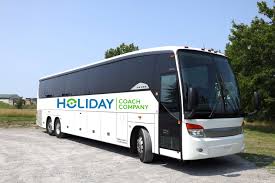
Charter Bus for Mission Trips: Group Travel Planning for Service Outreach
How to plan charter bus transportation for church mission trips — distance planning, gear storage, driver housing, and multi-day travel logistics.
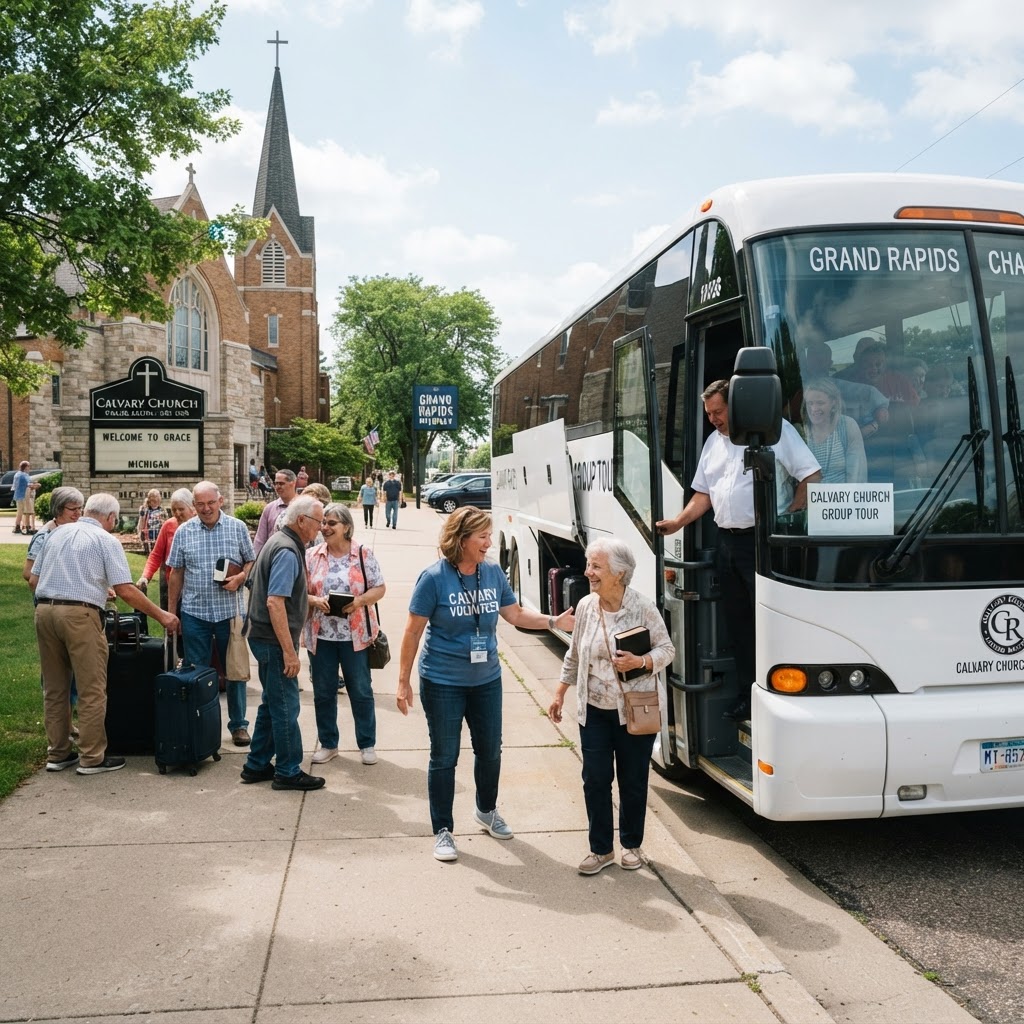
Coach Bus Grand Rapids Church Groups | Charter Bus Retreat Transportation
Coach bus Grand Rapids church group and retreat transportation — charter bus service for youth groups, choir trips, and congregation outings across west Michigan and beyond.
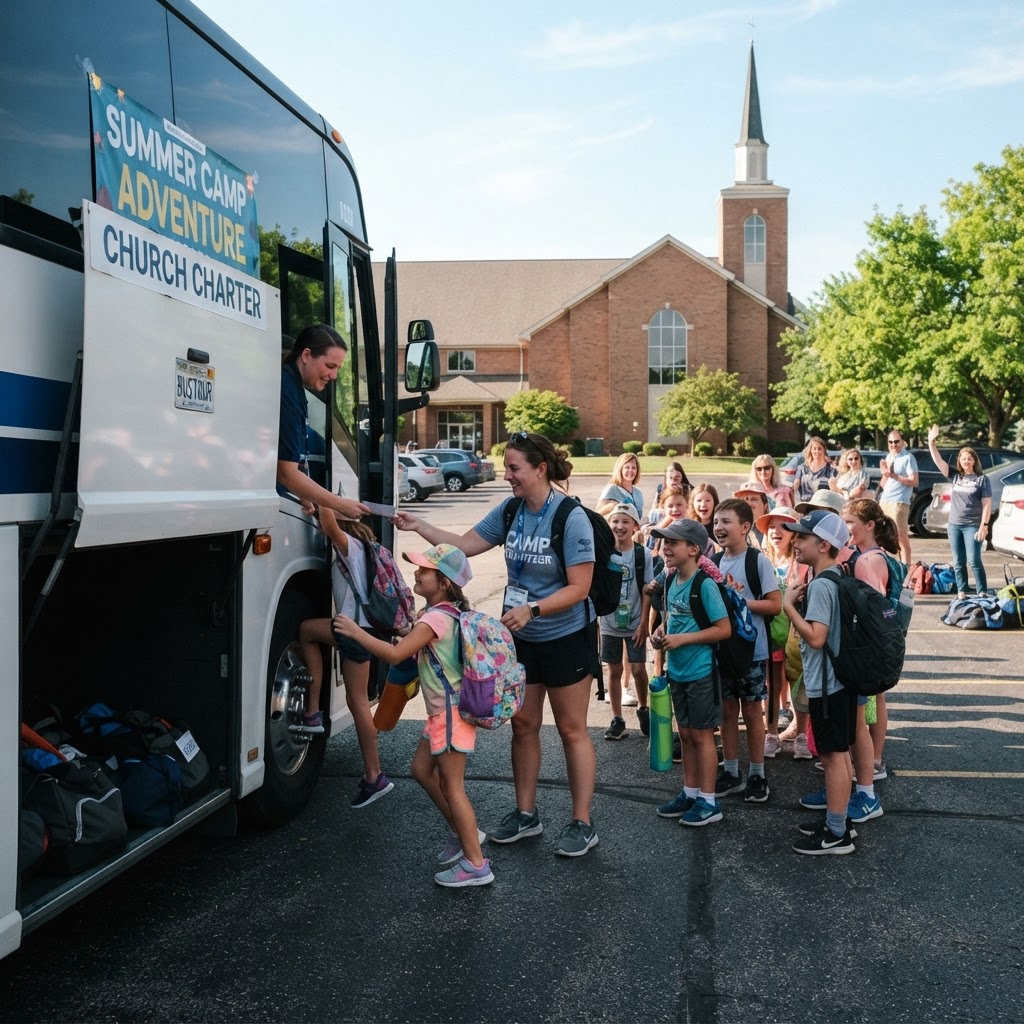
VBS & Summer Camp Charter Bus: Group Transportation for Children's Ministry Programs
Move your church's kids safely to Vacation Bible School and summer camp. Charter bus and coach bus transportation for children's ministry programs across Michigan and the Midwest.

Youth Group Charter Bus: Safe Transportation for Church Youth Trips
Move church youth groups to camps, conferences, and mission trips safely with a charter bus — supervised, comfortable, and on-time group travel for teens.