
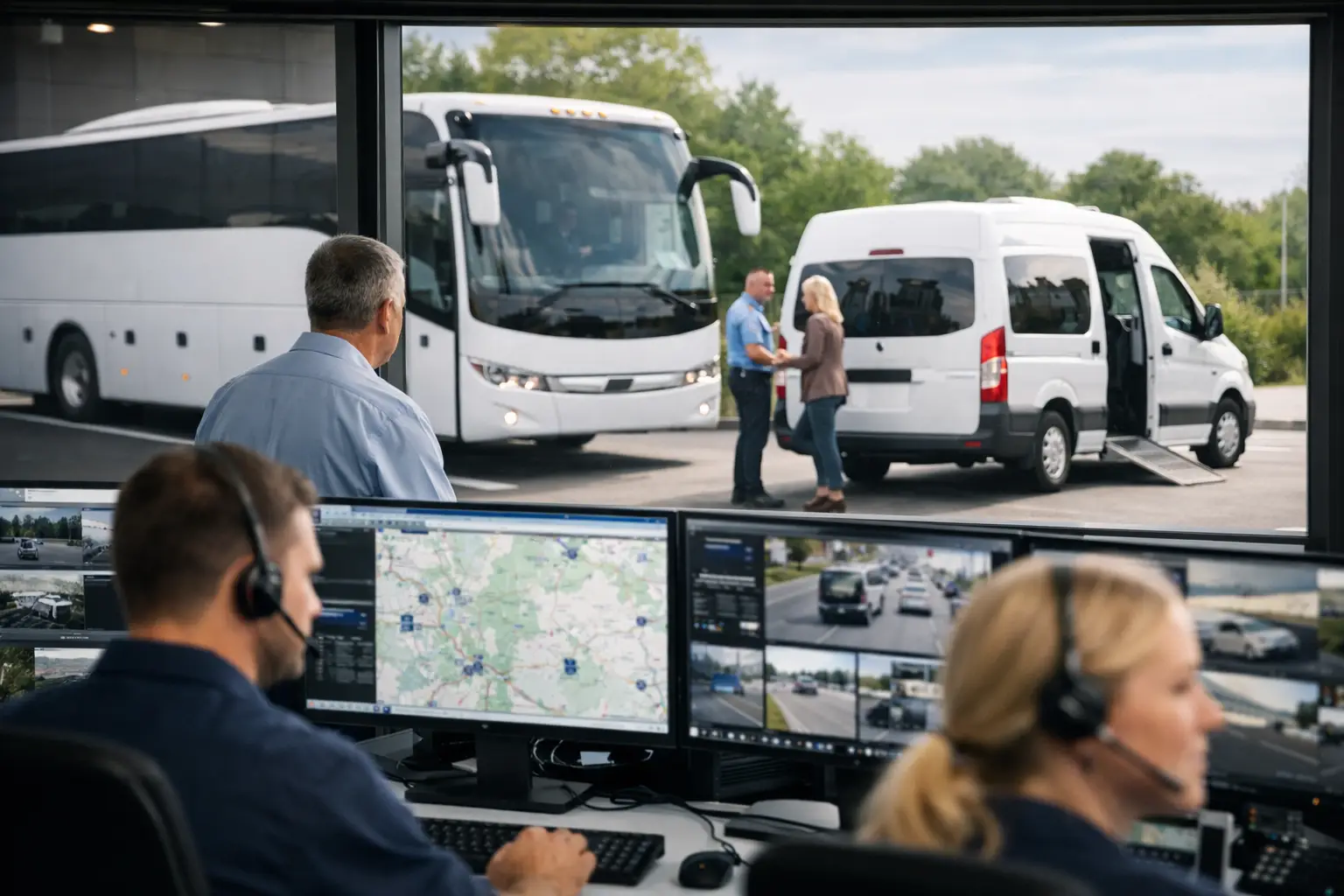
At 4:45 a.m., before the first passenger boards and long before a client asks for a status update, the coach transport operations center is already making decisions that shape the entire day. Vehicle assignments are being confirmed, route risks are being reviewed, driver availability is being checked, and open issues from the prior shift are being cleared. For any operator managing charter, shuttle, tour, or contract work at scale, this function is not administrative overhead. It is the operating layer that keeps service dependable.
For smaller companies, operations often start as a set of disconnected habits - a dispatcher handling calls, a maintenance lead tracking issues on paper, a scheduler relying on experience, and ownership stepping in when something goes wrong. That model can work for a limited fleet. It becomes fragile when demand grows, service lines diversify, or customers expect real-time visibility. At that point, a more structured operating center is no longer optional.
Why a coach transport operations center matters
A coach business is judged on outcomes passengers rarely see directly. The bus arrives on time or it does not. The driver has the right credentials or does not. A mechanical issue is contained early or becomes a roadside event. What sits behind those outcomes is operational coordination.
A coach transport operations center creates a single point of control across dispatch, fleet status, driver compliance, customer communication, and exception management. That does not mean every function has to sit in one physical room. In many modern organizations, the center is digital first. What matters is that there is one operating logic, one source of truth, and one accountable structure.
This is especially relevant for operators balancing multiple revenue streams. Charter work, recurring shuttle contracts, school-related movements, event transportation, and medical or mobility-adjacent services all place different demands on the fleet. Without centralized oversight, each service line can develop its own workarounds. Over time, those workarounds create risk, inconsistent service standards, and weak reporting.
The core functions inside the operations center
At a practical level, the operations center connects four disciplines that too many operators still manage separately.
Dispatch and live trip management
Dispatch is the most visible piece, but it is only one part of the whole. The operations team monitors departures, vehicle locations, service disruptions, driver changes, traffic conditions, and customer notifications. When a bus is delayed, the value is not merely knowing it is delayed. The value is having a process for what happens next - who is informed, whether the route can be recovered, whether a spare vehicle is needed, and how the incident is documented.
Live trip management becomes more critical as service complexity increases. A company running occasional charters can absorb some variability. An operator supporting daily contracts or multi-vehicle event moves has less room for improvisation.
Safety and compliance oversight
A disciplined operations center keeps safety and compliance visible during the day, not just during audits. Driver qualification status, hours limitations, vehicle inspection records, incident reporting, and route-specific requirements all affect whether service can legally and safely move.
This is one of the clearest differences between an operator that has grown and one that has matured. Growth adds trips and vehicles. Maturity adds control systems. If compliance information lives in separate folders, spreadsheets, or individuals' memory, the organization is relying on luck more than process.
Fleet readiness and maintenance coordination
Fleet maintenance is often treated as a back-shop function, but in a strong coach operation it is tied directly into dispatch planning. The operations center needs visibility into which vehicles are road-ready, which are restricted, which have recurring defects, and which should be held as spares.
That visibility changes decision-making. Instead of assigning based only on availability, teams can assign based on suitability, reliability history, route demands, and replacement options. The trade-off is that this requires better data discipline. If defect reporting is weak or maintenance status updates lag, the operating center is making decisions on outdated information.
Customer and contract accountability
The best operators know that client confidence is built through predictability. A corporate shuttle customer, school partner, event organizer, or institutional buyer wants confirmation that the operation is controlled. They do not want fragmented updates from several departments.
A centralized operations model supports that expectation. Service performance, issue escalation, response times, vehicle substitutions, and route exceptions can all be tracked through one structure. That improves communication, but it also improves accountability internally because ownership of the issue is clearer.
From dispatch desk to command function
Many operators use the term dispatch when they actually need an operations center. The difference is strategic. A dispatch desk reacts to the day. A command function shapes it.
That distinction matters for owners thinking about scale, succession, or exit. Buyers and enterprise partners are not only looking at revenue and fleet count. They are evaluating whether the business can perform consistently without depending on a few long-tenured people who hold the operation together informally.
An operation built around institutional processes is easier to integrate, easier to expand, and easier to value. That is one reason a structured center has significance beyond daily service delivery. It becomes part of the company's operating architecture.
Technology changes the role of the coach transport operations center
Technology does not replace operations discipline. It exposes whether it exists.
A modern coach transport operations center should be able to pull together telematics, GPS location, driver workflows, preventive maintenance status, communication logs, and service exceptions into a usable operational view. That does not mean every company needs an expensive, fully custom system. It means the technology stack should support coordinated action rather than isolated data collection.
There is a common mistake here. Some operators invest in point solutions for routing, maintenance, cameras, driver messaging, and customer updates, but never define how those systems work together. The result is more software without more control. Real improvement comes when the operating model is clear first, and the technology is selected to support it.
For diversified transportation groups, this becomes even more important. Shared digital infrastructure can standardize safety thresholds, reporting frameworks, communication procedures, and escalation paths across divisions while still allowing service-specific workflows. That balance - standardization where it matters, specialization where it is required - is where enterprise transportation platforms gain operational advantage.
What operators should evaluate in their current model
If you run a charter or coach business, the useful question is not whether you already have people doing operations work. You almost certainly do. The better question is whether that work is coordinated, measurable, and scalable.
Start by looking at how decisions are made during service disruptions. If the answer depends on who is on shift, the model is person-dependent. Review how vehicle readiness is communicated to dispatch. If that process is informal, fleet risk is being transferred into the service day. Examine whether customer communication during delays is standardized or improvised. Inconsistent communication usually signals inconsistent control.
You should also look at reporting. If post-trip review focuses only on major failures, smaller recurring issues may be quietly eroding margin and service quality. Late departures, avoidable substitutions, excess idle time, preventable call volume, and incomplete inspection workflows rarely look dramatic on their own. Together, they reveal whether the operation is truly being managed.
Build, centralize, or integrate?
There is no single model that fits every operator. A regional company with a modest fleet may not need a large centralized team. It may need clearer ownership, stronger digital tools, and better cross-functional workflows. A multi-division or multi-location operator may need a true operations center with shared visibility across brands and geographies.
This is where leadership has to be honest about the business stage. If the goal is stability, the priority may be standard operating procedures and stronger compliance integration. If the goal is growth, the priority may be central visibility and exception management. If the goal is an eventual transaction, the priority may be reducing dependence on informal knowledge and proving operational repeatability.
For some companies, partnering with a platform that brings both transportation experience and fleet technology capability can accelerate that transition. NextGen Mobility reflects that broader model by connecting specialized transportation operations with shared oversight and advanced fleet systems. For operators considering modernization or succession, that kind of integrated structure has practical value because it addresses operations, not just ownership.
The strongest coach businesses are not held together by constant intervention. They are supported by a center that sees the network clearly, manages exceptions early, and turns information into control. If your operation is growing faster than your internal coordination, that is usually the moment to treat the operations center as infrastructure rather than support overhead.